
By the Walking Paws Rehab team. Reviewed by Dr. Danyel Wynn, DVM, CCRT.
If your veterinarian or rehab team has suggested laser for your dog, it is fair to wonder what the light is actually doing and whether it is safe. Therapeutic laser, also called photobiomodulation, is one of the most common tools in canine rehabilitation, and for most dogs it is well tolerated. Like any treatment, though, it works best when it is dosed carefully, aimed at the right areas, and skipped in the few situations where it should not be used. Here is what we can tell you about how it works, what the research does and does not show, and how we use it at our Boulder and Denver clinics.
What therapeutic laser does
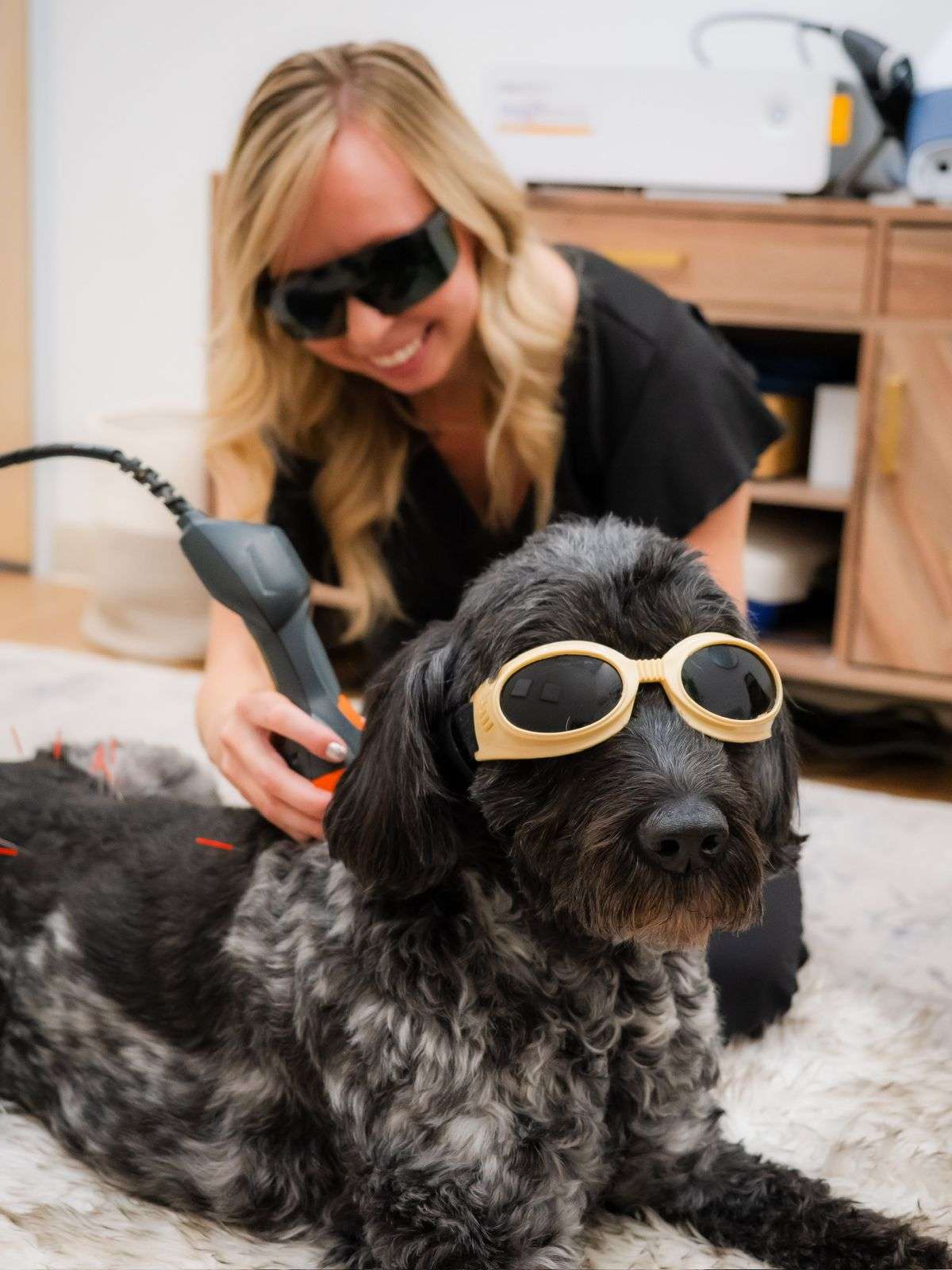
Therapeutic laser is a low-level, non-surgical light treatment. It does not cut or burn tissue. Instead, a handheld probe delivers light to an injured or painful area, and the cells absorb that energy. The leading explanation is that this nudges cell activity in a helpful direction, which may ease pain, calm inflammation, and support circulation and tissue healing. Dogs usually feel it as mild warmth, or nothing at all, and many settle into a session quietly. You can read more about the treatment on our laser therapy page.
What the research says
The research on therapeutic laser is encouraging. Studies in dogs and in other species suggest laser can help with pain and inflammation, and there is growing interest in its role for osteoarthritis, wound and incision healing, and soft tissue injury. Researchers continue to refine the ideal devices, wavelengths, doses, and schedules, so the exact protocol is tailored to each dog. That is why we think of laser as a valuable part of a plan rather than a stand-alone cure. It is rarely the only thing a dog needs, and it should not replace a diagnosis, medication when it is needed, or an exercise program.
Is it safe?
When it is delivered by trained staff using appropriate settings, therapeutic laser has a good safety record, and serious side effects are uncommon. The risks are mostly about eyes, heat, and choosing the wrong patient or the wrong area. Safety in practice comes down to a handful of habits.
Eye protection comes first
Laser light can harm the eyes, so everyone in the room needs protection. That means safety glasses for the team and for you if you are staying with your dog, and protective goggles for your dog. Some dogs take to their goggles quickly, and others need a little patience and a treat or two. We keep eye protection in several sizes and clean it between patients, because a comfortable, well-fitting pair makes the whole visit easier.
Areas we avoid or approach with caution
Laser is generally not directed over a suspected or known tumor, because we do not want to stimulate abnormal tissue. If you tell us about a new lump, or we find one during an exam, we will usually hold laser near that area until it has been looked at, and we may recommend diagnostics and let your regular veterinarian know. We also take extra care over the abdomen of pregnant dogs, over areas that are actively infected, and over very dark or heavily pigmented skin and coat, which absorb more energy and can get warm faster. If your dog has a medical condition we should know about, such as cancer history or a seizure disorder, please mention it at the first visit so we can adjust the plan.
Dose and technique matter
More is not better with laser. A therapist decides which areas to treat and what settings to use, and the amount of time varies with how many areas are involved and how much energy each one needs. We keep the probe moving or positioned thoughtfully, watch your dog’s comfort, and look at how the skin and coat are responding. Because thick fur can scatter light, we sometimes adjust the approach for long-coated breeds. If your dog seems sore or restless afterward, tell us so we can change the next session.
Where laser fits into a rehab plan
Laser is often used early, when pain and swelling are the main problems. After an operation, many dogs benefit from it alongside the plan your surgeon set out, and our post-surgical rehab program builds on that. For dogs with arthritis, it can be one part of a daily and weekly routine, which we describe in our guide to a senior dog arthritis routine. Once pain settles, the focus shifts toward movement, strength, and balance, using tools like the underwater treadmill, hands-on manual therapy, and targeted exercise. If you are following a surgical timeline, our TPLO recovery timeline shows how these pieces come together. Your surgeon’s protocol always comes first.
Questions to ask before your dog starts
It is reasonable to ask who will perform the treatment, what area is being treated and why, how many sessions to expect before reassessing, and what signs mean you should call. A good plan includes a clear goal, such as easier rising in the morning or more comfortable weight bearing, and a point at which you and the team check whether it is working. If you are not sure whether your dog is in pain in the first place, our article on recognizing pain in pets can help, and our FAQ and what to expect page explain how a first visit goes.
On the practical side, we keep pricing simple: one price for the initial evaluation and one flat rate for each one-hour follow-up, no matter which treatments we use, so laser does not add a separate charge. Our guide to dog physical therapy costs in Colorado explains what can add to a plan, such as diagnostics, medications, and supportive devices.
Ready to talk it through?
If you would like to know whether laser could help your dog, we are happy to evaluate them and explain every step. You can visit us in Boulder, open every day, or in Denver, open Tuesday through Saturday, and no referral is required. Call (720) 639-3924 or schedule an appointment online.